Project in Practice
Documentation and discussion of practing origami collectively, and Folded Dialogue's outputs
Zine Making
The Process Development Workshop held by my supervisor inspired me to create a zine titled 'a poetic origami crane guide'. During the workshop, I was beginning to understand what the idea of 'felt phenomenology' meant, proposed by Patterson (2013) [see in Research & Application]. The tactile aspect of flipping through the pages was desirable in order to explore and expand on the aspect of tactility when folding origami.


This was created using Canva, and I have hand-drawn each diagram in every step because the imperfect lines are meant to reflect and embrace the elements of human touch. During the process, it felt hypocritical of me to use digital tools such as my laptop and stylus to put this together, but referring back to my research question, (How do we negotiate our relationships with digital technologies when taking part in origami?) this demonstrates the act of not entirely rejecting the digital. Having the zines printed out physically exemplifies the rediscovery of the tactile experience in itself.

The formatting and sizing of the zine was a bit of a challenge; a trial and error process. The first print was not a success as some of the words cut off at the bottom, and the pages bled into their neighbouring sections - so adjusting the alignments after each print was how I managed to get a cleaner look at the end.

Collective Origami Workshops
The methodology behind my research question involved workshops where participants are invited to fold origami in a group setting. It was encouraged to speak freely and say whatever comes to mind, and to also not feel pressured to keep talking to fill the silence. This also involved a degree of autoethnographic engagement, as I participated directly in the folding process, asking questions as prompts for starting conversations, and reflected on my own embodied experiences as part of the research.


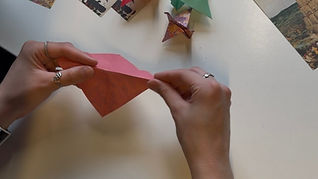
During the workshop I observed the participants engagement with the paper and found varying responses. Some found it easy to follow the step-by-step instructions, either from the zine I created or from my verbal instructions. Others found it difficult due to various reasons: device notifications, unclear instructions, or having trouble multi-tasking (staying on-topic in conversation while trying to crease the correct folds.
Feedback from the participants was generally positive, stating that it was nice to spend time with each other and do something creative in the midst of an academically stressful time-frame. The participants called for other origami variations to fold, and to which I printed out different guides to use for the next workshop.


Collectively we noticed great improvement with our origami-making skills, and found it easier to follow the instructions after the previous workshop. Because of already knowing what to expect, the participants seemed more relaxed and present in the room - folding almost became secondary to the conversations being had.
Written Reflective Feedback


Sheets of paper with handwritten open -ended questions at the top were handed out to the participants, prompting them to reflect on the sessions and describe their thoughts, feelings and opinions after having done the origami workshops.